
Copper can save space today and return more metal value at retirement.
Contents
- Why a buyer would specify copper
- A real manufacturer comparison: smaller did not mean lower losses
- Plain English: copper fits more electrical capacity into less space
- Put the premium into dollars per kVA—and lifetime dollars
- The copper is still worth something after service ends
- Where these Eaton units make sense
| Decision | Copper | Aluminum |
|---|---|---|
| Space | Smaller conductor for the same resistance. | Larger conductor to match copper’s resistance. |
| Purchase cost | Usually a premium; fit and schedule can justify it. | Lower conductor cost and weight. |
| Energy cost | Lower bills only if tested losses are lower. | Can meet the same loss specification. |
| Hot or cold climate | Cooling and thermal design decide. | Cooling and thermal design decide. |
| Mechanical design | Stronger metal; winding support still matters. | Engineered supports can meet fault duty. |
| Retirement value | Higher conductor-metal recovery value. | Lower recovery value; less initial metal investment. |
Why a buyer would specify copper
A copper winding is a legitimate premium feature. It puts more electrical conductance into a given conductor envelope. That can matter inside a constrained transformer bay, when replacing a unit on an existing pad, or when an approved project specification already calls for copper. Its recoverable metal also remains an asset after the insulation system or the application has reached the end of its useful life.
Those benefits can justify a premium without pretending the word “copper” is an efficiency certificate. The commercial question is what the offered transformer delivers: footprint, losses, voltage, impedance, condition, schedule and price. An available copper unit may be a better project purchase than a cheaper aluminum design that arrives too late.
We do not have the original buyer’s 2022 purchasing rationale for this Eaton lot. Copper could have been required by its specification, layout or commercial preference; the order date alone does not establish which reason applied.
A real manufacturer comparison: smaller did not mean lower losses
Eaton’s 2016 example compares 2,500 kVA padmount designs at 13.8 kV to 480Y/277 V. This is a historical design comparison—not a quotation or test report for our 2,600 kVA units.
| Metric | Aluminum | Copper |
|---|---|---|
| Dimensions, H × W × D | 81 × 104 × 73 in | 81 × 94 × 72 in |
| Footprint, calculated | 52.7 ft² | 47.0 ft²; about 11% smaller |
| Efficiency at 50% load | 99.53% | 99.53% |
| Efficiency at full load | 99.32% | 99.27% |
| No-load / load losses | 2,402 / 14,732 W | 2,015 / 16,558 W |
| Relative purchase price | Baseline | 13.8% higher |
This example earns its place in a buying discussion: the copper design buys space, but not a full-load energy saving. A different optimized pair can produce a different result. Ask for guaranteed losses at the specified reference temperature rather than extrapolating from the metal.
Plain English: copper fits more electrical capacity into less space
Think of the conductor as the electrical path around the core. Make that path longer and resistance increases. Make it wider or thicker and resistance decreases. Aluminum needs a larger path cross-section to match copper’s resistance at the same length and temperature. It does not have to run hotter: the designer can give it that extra cross-section.
Using annealed electrical-conductor aluminum at 61.8% IACS conductivity, a copper conductor with a 100 mm² cross-section is matched by about 162 mm² of aluminum. A geometrically similar round or square conductor is then about 27% larger in each linear dimension—not 62% larger in diameter. A foil winding can gain area through width, thickness or both.
Engineering detail: geometry, workability and temperature
Equal resistance is a design constraint, not a material substitution
R = ρ × L / A. At 20°C, use ρ = 0.017241 Ω·mm²/m for standard annealed copper and 0.027898 for annealed EC-O aluminum. Their ratio is 1.618. At equal length, aluminum therefore needs 1.618 times the area. If aluminum’s mean turn length is 10% longer, the area requirement becomes 1.780 times copper’s.
Both metals can be formed into transformer conductor. Temper, bend radius, foil or wire arrangement, insulation thickness and production tooling determine the practical geometry. Enlarging the conductor can enlarge the winding window, change mean turn length and leakage reactance, and alter the core, tank and cooling system. AC eddy and circulating losses also depend on conductor arrangement. A cost model that swaps metals while freezing all those dimensions is not a transformer quotation.
Using densities of approximately 8.89 g/cm³ for copper and 2.703 for aluminum, the equal-length, equal-DC-resistance aluminum conductor weighs about 49% as much. With a 10% longer aluminum path, that rises to about 60%: the mass ratio contains the square of the length ratio. Thus raw conductor cost is roughly 0.49 × (aluminum $/lb ÷ copper $/lb) at equal length. This excludes insulation, core, tank, fabrication and all other transformer costs.
Hot climates: the material difference is small after correct sizing
Near ordinary winding operating temperatures, R(T) = R20 × [1 + α × (T − 20)]. For standard copper α is about 0.00393/°C; for this EC-O aluminum example it is about 0.00408/°C. At 100°C their resistance multipliers are about 1.314 and 1.326. If sized for equal resistance at 20°C, aluminum is only about 0.9% higher at 100°C—not 62% higher.
Both resistances fall as the winding cools. In a hot climate, specify the ambient, load cycle, temperature rise, hot-spot limit and cooling arrangement. In cold service, fluid viscosity and equipment starting conditions also matter. Neither metal name establishes the transformer’s ambient rating.
Put the premium into dollars per kVA—and lifetime dollars
Compare matched offers at the same voltage, impedance, thermal duty and tested condition. Then price the differences. The example below is a project-screening calculation using invented bids and loss inputs; none is a quote or measured loss for the Eaton inventory.
| Input or result | Calculation |
|---|---|
| Aluminum bid / copper bid | $65,000 / $78,000 → $25 / $30 per kVA |
| Copper premium | $13,000 → $5 per kVA |
| Assumed copper loss advantage | 8 kW less full-load load loss; equal no-load loss |
| At a steady 50% load | 8 × 0.5² = 2 kW average saving |
| At $0.08/kWh, continuously | 2 × 8,760 × $0.08 = $1,402/year |
| 20 years, 8% discount rate | Energy saving present value ≈ $13,761 |
| Assumed extra NET retirement value | $10,000 in year 20 → present value ≈ $2,145 |
| Combined present-value benefit | ≈ $15,906 versus a $13,000 premium |
The result changes quickly with loading. At 25% steady load, the same assumed load-loss advantage saves only about $350/year. If measured losses are equal, the energy saving is zero. For variable loads use the time-weighted mean of load fraction squared, not the square of the average load. No-load losses accrue whenever the transformer is energized, even if production stops.
The copper is still worth something after service ends
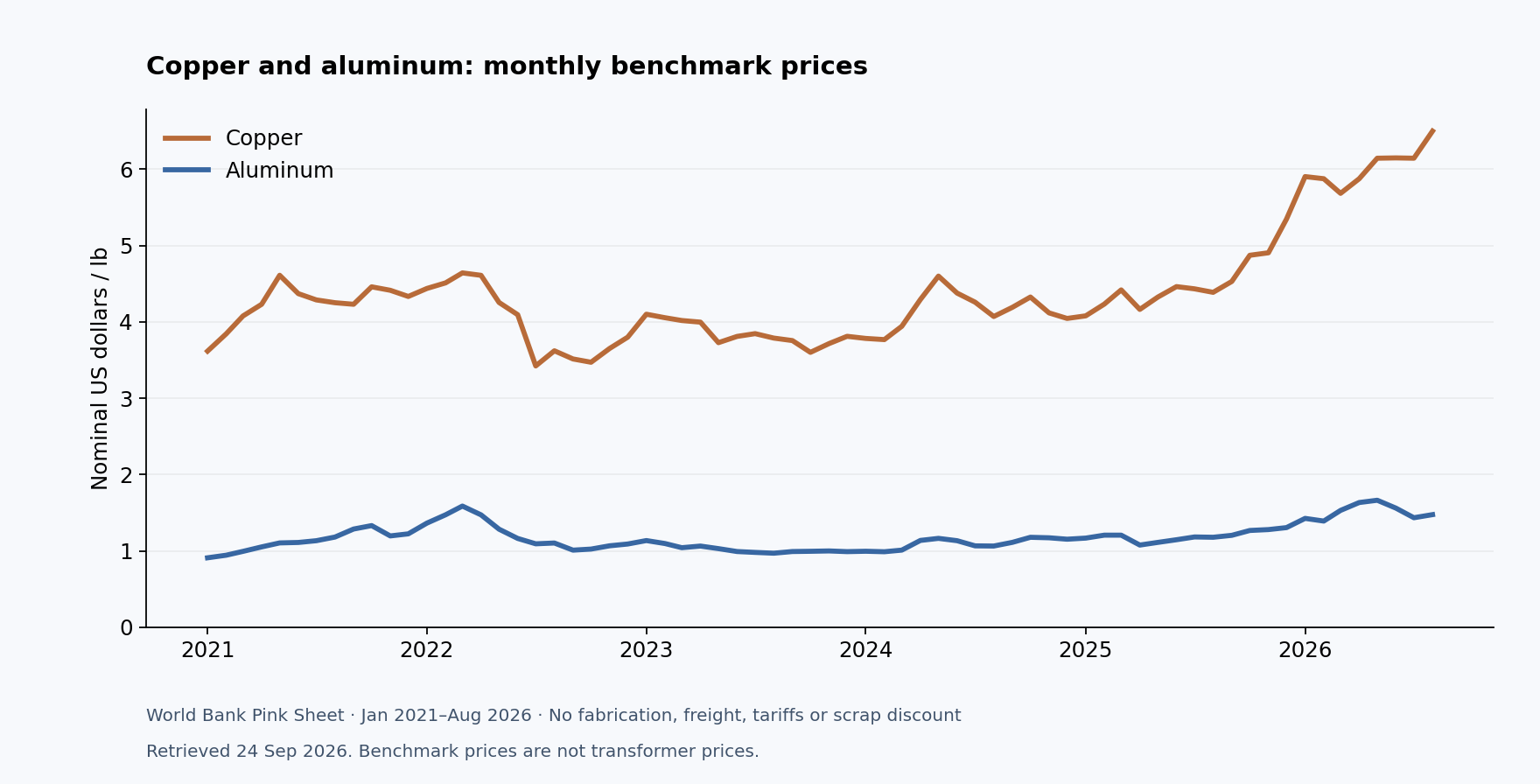
The owner has been told that gross scrap proceeds from one of these copper Eaton units could be around $15,000 before dismantling labor. That is a preliminary owner-reported estimate, not a verified recovery quote. It is worth investigating because the potential value is commercially meaningful.
Obtain a written recycler breakdown: recoverable copper weight and grade, payable price, steel credits, fluid handling, dismantling, transport and disposal. Subtract those costs to get net recovery. A $15,000 gross estimate does not mean $15,000 cash in the owner’s pocket. Nor can we infer the aluminum alternative’s salvage value without its actual material weights.
Even then, timing matters. Ten thousand dollars of additional net recovery twenty years from now is worth about $2,145 today at an 8% discount rate. Copper can retain or gain commodity value while equipment depreciates, but its price also falls. Treat residual metal value as a useful offset to lifetime cost, not a guaranteed investment return.
Copper and aluminum price history
Monthly benchmark prices show the metal-value exposure. They are not scrap payout quotes: grade, recovery costs and local deductions change the amount a recycler pays.
Where these Eaton units make sense
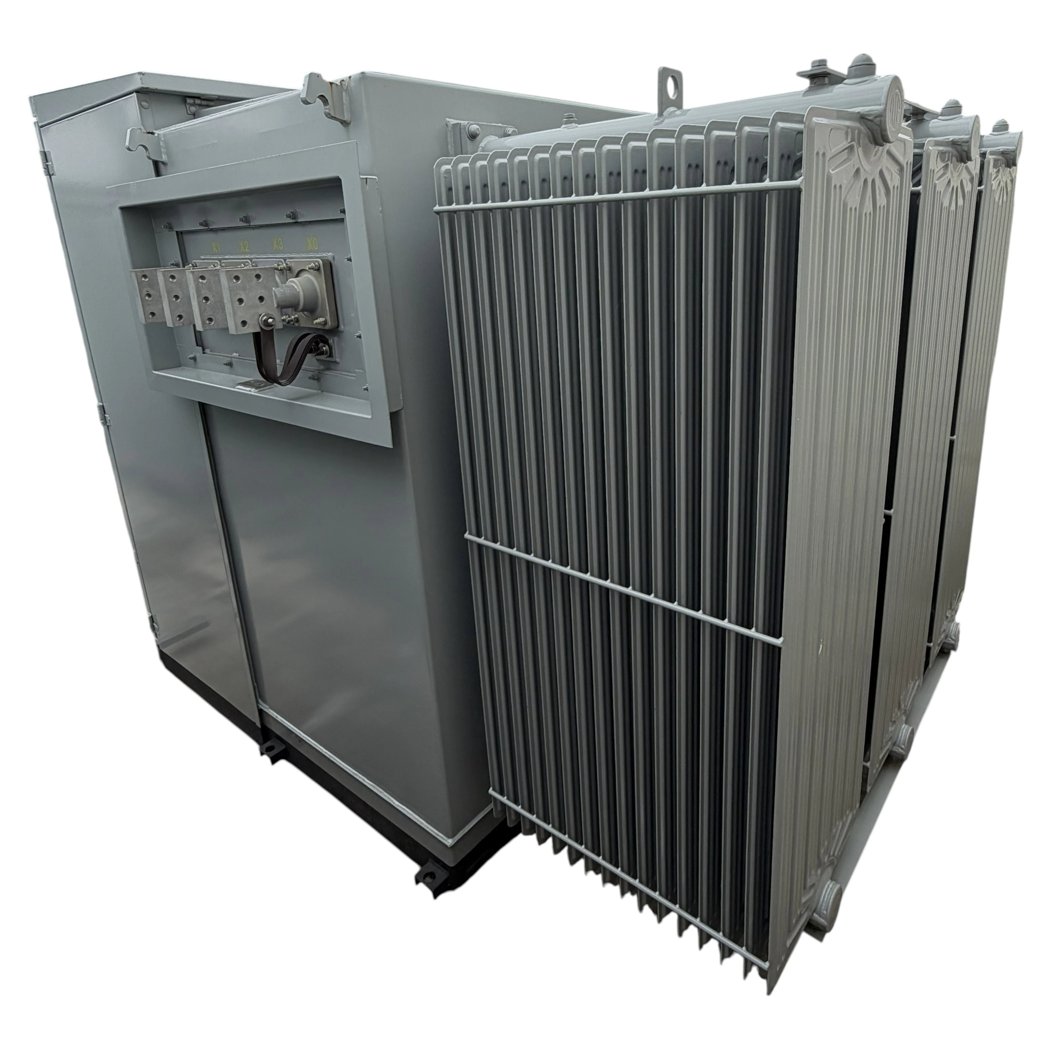
Our 2,600 kVA Eaton copper-wound FR3 units are a fit to investigate when the project needs 34.5 kV to 416Y/240 V. The unused group and the damaged repair group are separate offers. Match the voltage first—416 V is not 480 V—then compare the selected serial’s records, required tests, delivered cost and installation schedule. The best copper purchase is the one that fits the project and wins on total value.
Sources & calculation basis
- Eaton: historical padmount design comparison, TC202003EN (2016)
- Schneider Electric: oil-filled transformer dimensions, FA269603
- NBS/NIST: Copper Wire Tables, Handbook 100
- NBS/NIST: Aluminum Wire Tables, Handbook 109 (EC-O grade)
- World Bank: commodity-price data through August 2026
- US DOE: distribution-transformer loss methodology